
Tarsus, Turkey: 4 Bible History Stops and a Museum Bonus

Tarsus is a modern city built over the ancient city where the apostle Paul was born. When we visited, we found four stops that helped us picture its history: an excavated Roman road, the Tarsus Museum, a site traditionally associated with Daniel, and Paul’s Well. I’ve included our photographs and a map link for each place.

The first four stops are in Tarsus. At the end, there’s a bonus artifact from Tarsus that we saw in Istanbul.

1. The ancient road in Tarsus
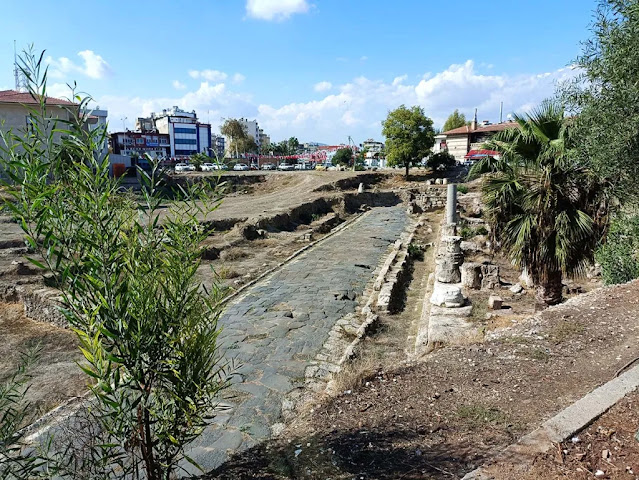
Excavated ancient road in Tarsus, Turkey
The excavated road in Tarsus.

Find the ancient road on Google Maps. It runs beside the Tarsus Museum, so it makes sense to see these two places together.

We could see the excavated area around the road and the basalt paving. It was discovered during a modern construction project, and ancient drainage runs beneath it. Standing here gave us a glimpse of the city Paul knew, although we cannot know whether he walked on this particular stretch.

2. Tarsus Museum

Find the Tarsus Museum on Google Maps. We enjoyed seeing objects from the city after visiting the road next door.

Paul described himself as a citizen of Tarsus, “no obscure city” (Acts 21:39). The museum helped us imagine the scale and life of the ancient city.

Ancient column fragment displayed at the Tarsus Museum
A column fragment on display in the museum.

We also noticed coins bearing the name and titles of Tarsus. They were a memorable reminder of how the city represented itself in antiquity. The museum’s oil lamps were another favorite: everyday objects that made the period feel more tangible.

Ancient oil lamps displayed at the Tarsus Museum
Oil lamps displayed at the Tarsus Museum.

Another display showed Pan, a figure from Greek and Roman mythology. Seeing the statue prompted us to think about references to goat-shaped demons in the Bible; the statue itself does not establish a direct connection to any particular Bible passage.

Statue depicting Pan at the Tarsus Museum
A figure of Pan at the museum.

3. The site traditionally called Daniel’s Tomb

Find the site on Google Maps. We visited a place in Tarsus that local tradition associates with the prophet Daniel. There are other places said to be his burial site, and the Bible does not say that Daniel came to Tarsus. We treated this as a local tradition, not a verified tomb.

Site traditionally identified as Daniel’s tomb in Tarsus
The site traditionally associated with Daniel.

The site is beneath a mosque, so you enter the mosque area to see it. That is useful to know before deciding whether to add it to your visit.

4. Paul’s Well

Find Paul’s Well on Google Maps. This is another place linked to Paul by tradition. We were told that visitors have associated the well with him for centuries, but its connection to Paul cannot be confirmed.

Well traditionally associated with the apostle Paul in Tarsus
Paul’s Well, as it is known today.

We saw the well, a covered area said to mark the place where Paul was born, and the surrounding grounds. Even without accepting the traditional identifications, we enjoyed this small site and its setting.

Covered remains at the site of Paul’s Well in Tarsus
The covered remains near the well.
Landscaped park around Paul’s Well in Tarsus
The small park around Paul’s Well.
Another view of the park at Paul’s Well
Another view of the grounds.

Bonus: a Tarsus artifact in Istanbul

This final item was found in Tarsus, but you cannot see it in Tarsus. We saw the statue of Marsyas at the Istanbul Archaeology Museums. If you are also visiting Istanbul, it offers another glimpse of an artifact connected with the ancient city.

Statue of Marsyas found in Tarsus and displayed in Istanbul
The Marsyas statue from Tarsus, displayed in Istanbul.

Marsyas belongs to a story from classical mythology. We found the statue striking, but it should not be taken as evidence for the specific way Jesus was executed.

Planning your visit

If you have limited time in Tarsus, start with the ancient road and the museum beside it. Then decide whether the two traditional sites interest you. We found a car useful for getting between places. Check the current museum hours, entry fees, and access at each location before you travel; these details can change.

For more places we have visited in Turkey and beyond, see our Bible History Travel guide. You might also enjoy our visit to ancient Smyrna in Izmir.

Comments

Popular posts from this blog

The Garden of Eden - Possible Modern Day Location

To begin with, I would like to start with a short disclaimer about the Garden of Eden… No one really knows where the exact location of the Garden of Eden was. The book Insight on the Scriptures says “it’s location is lost to man except for the divine record of its existence.” But it’s interesting that it also says this, “The traditional location for the garden of Eden has long been suggested to have been a mountainous area some 225 km (140 mi) SW of Mount Ararat and a few kilometers S of Lake Van, in the eastern part of modern Turkey.” Insight on the Scriptures – 1, p.677   This explains why the Garden of Eden is marked where it is on the map above. Of course this is an older Bible version and there is a question mark beside it’s location. But it arouses curiousity. Why was this place chosen? So why is this location suggested? Again, the book of Genesis and the Insight book give a clue. Here it is: Genesis 2:11 – Now there was a river flowing out of Eden to water the ga...

My Journey to Kursunlu Waterfall in Antalya, Turkey with My Wife - A Canadian's Perspective

As a lover of nature and travel, I was thrilled to explore the Kursunlu Waterfall in Antalya, Turkey, a destination that promised to be a highlight of our trip. My wife and I, both ardent admirers of natural beauty, were eager to discover this Turkish gem firsthand. Discovering Kursunlu Waterfall Kursunlu Waterfall, tucked away in a picturesque nature park near Antalya, is a haven of tranquility and beauty. I found myself comparing its serene ambiance to some of the most beautiful natural sites we had visited worldwide. The journey to this waterfall was an adventure in itself, with each turn revealing more of Turkey's splendid landscape. Our Arrival at Kursunlu Waterfall Upon arriving at Kursunlu Waterfall Park, my wife and I were greeted by lush greenery and the soothing sound of water. The contrast between the bustling city life of Antalya and the peacefulness of the park was stark and refreshing. Paying a small entrance fee felt like a small contribution to preserving this sli...

The Bible in the Pergamon Museum in Berlin

The most fascinating thing about the Pegamon Museum in Berlin is how the objects there are connected to the Bible. In this page I will try to share the top things that not only relate to the Bible, but confirm it’s authenticity. I will also share things that bring Bible accounts to light and make them more realistic. 1. The Ishtar Gate This is the crown jewel of the museum and has much significance to the Bible. It was likely seen by many Israelite captives, including Daniel himself! It was built by Nebuchadnezzar around 575 BCE. The walls were disassembled in Iraq and moved to this museum early in the 20th century. The beautiful and colorful glazed bricks retell the glory of Babylon. Original gate brought to Berlin from Babylon This was one of the gates through which one could enter Babylon. What is more impressive is that which is not seen. Babylon was so fortified that this wall extended 14 meters (45 feet) underground! It accounts for the confidence and pride that Nebuchadnezzar e...